What Exactly Is HappyHorse-1.0? From Mysterious Dark Horse to Official Alibaba Confirmation – The Full Reveal
In early April 2026, a previously unknown AI model named HappyHorse-1.0 appeared without warning — and immediately disrupted the entire AI video generation landscape.
No official announcement.
No marketing campaign.
No company attribution.
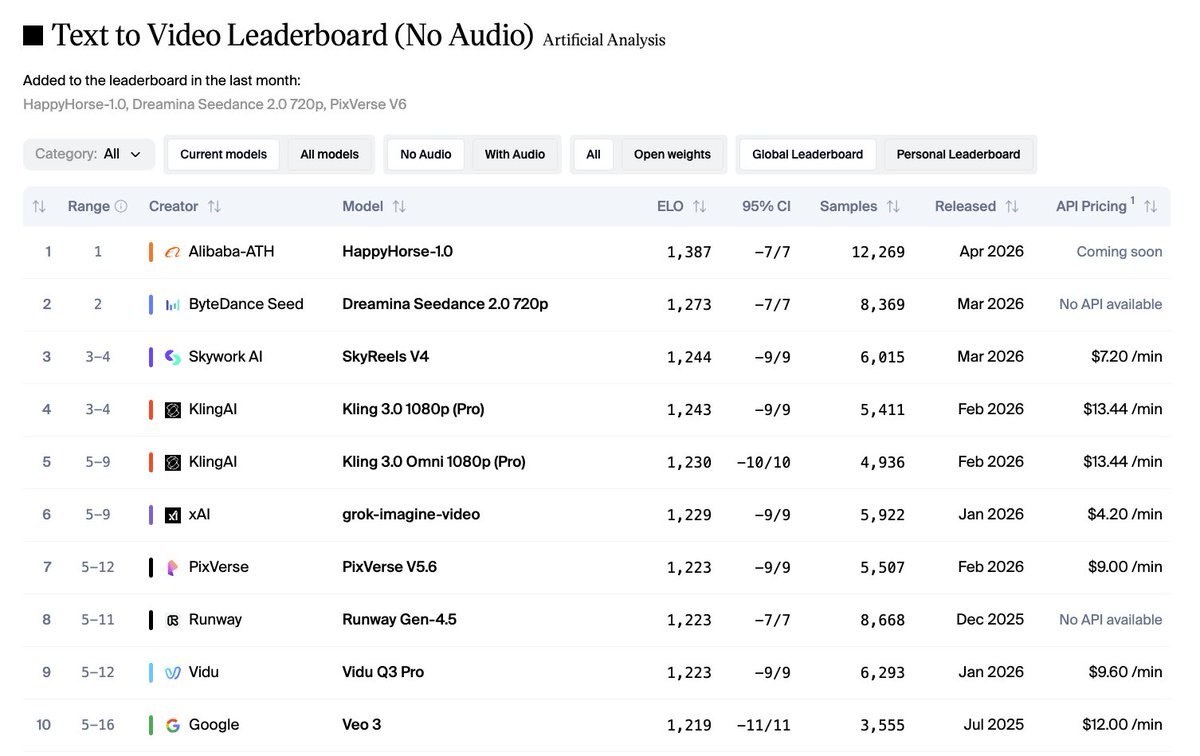
Yet within days, it climbed to the top of the Artificial Analysis leaderboards, outperforming leading models like Seedance 2.0 and Kling 3.0 in blind user evaluations.
This article provides a complete breakdown:
- What HappyHorse-1.0 actually is
- Why it ranked #1 so quickly
- Its core features and capabilities
- The official Alibaba confirmation
- And the real user pain points it solves (especially vs Seedance 2.0)
What Is HappyHorse-1.0? (Complete Overview)
HappyHorse-1.0 is a next-generation AI video generation model that transforms text prompts or reference images into cinematic-quality videos.
It introduces a major shift in architecture:
👉 A unified multimodal generation system where video and audio are produced together in a single pipeline.
Key capabilities include:
- Native 1080p HD video generation
- Integrated synchronized audio output
- Support for Text-to-Video (T2V) and Image-to-Video (I2V)
- Advanced motion synthesis and temporal consistency
- High prompt accuracy and semantic understanding
Unlike earlier tools, it is not just a generator — it is a complete video production system in one model
HappyHorse-1.0 Ranking: #1 on Artificial Analysis Leaderboards
One of the most important reasons behind the explosive attention is its verified ranking performance.
On the Artificial Analysis Video Arena (leaderboards):
- 🥇 #1 in Text-to-Video (no audio)
- 🥇 #1 in Image-to-Video (no audio)
- 🥈 Top-tier performance in audio-enabled categories (near #1)
These rankings are not based on marketing claims.
They are based on:
- Blind A/B testing
- Real user voting
- Large-scale comparison across models
This means users consistently preferred HappyHorse outputs over:
- Seedance 2.0
- Kling 3.0
- PixVerse V6
👉 This is a critical signal:
The model is not just technically strong — it is visually and experientially preferred by users.
Why HappyHorse-1.0 Became #1 So Fast
Its rapid rise is directly tied to solving the biggest limitations of existing AI video tools.
1. True Audio + Video Generation in One Pass
Most competing models still rely on:
- Video generation
- Audio added afterward
This often leads to mismatch and unnatural results.
HappyHorse-1.0 generates:
- Dialogue
- Background sound
- Environmental audio
- Lip-sync
👉 All in one step, resulting in far more coherent outputs.
2. Superior Motion and Temporal Consistency
Traditional problems in AI video include:
- Flickering frames
- Character inconsistency
- Unrealistic motion
HappyHorse improves:
- Frame stability
- Character continuity
- Natural movement
3. Strong Prompt Adherence
Instead of loosely interpreting prompts, HappyHorse:
- Follows instructions more precisely
- Maintains narrative structure
- Handles complex scenes more reliably
4. Multi-Shot Storytelling
Many AI tools are limited to single-shot clips.
HappyHorse supports:
- Scene transitions
- Consistent characters
- Narrative continuity
This enables full short-form storytelling, not just isolated visuals.
Core Features of HappyHorse-1.0
Text-to-Video and Image-to-Video
Supports both:
- Text → Video
- Image → Video
Within one unified system.
Native 1080p Output
- High-definition video generation
- Production-ready visual quality
Integrated Audio Generation
One of the standout capabilities:
- Audio is generated together with video
- Includes speech, ambient sound, and effects
- Eliminates the need for separate audio tools
Fast Generation Speed
- Near real-time generation online
- Efficient local inference on high-end hardware
This enables rapid iteration and creative testing.
Multiple Visual Styles
Supports a wide range of visual styles, including:
- Photorealistic
- Artistic
- Stylized cinematic outputs
The Real User Pain Points in AI Video (And Why HappyHorse Wins)
To understand its impact, it is critical to examine real frustrations — especially with models like Seedance 2.0.
1. Long Queue Times (Critical Bottleneck)
A major issue with Seedance 2.0:
- Long waiting queues
- Heavy congestion during peak usage
- Delayed generation times
For creators, this leads to:
- Interrupted workflow
- Slower content production
- Reduced efficiency
👉 HappyHorse focuses on fast generation, significantly reducing waiting friction.
2. High Cost Per Generation
Seedance 2.0 is often associated with:
- Higher usage costs
- Expensive scaling for frequent generation
- Limited experimentation due to pricing
This creates barriers for:
- Indie creators
- Small teams
- High-volume content production
👉 HappyHorse lowers this barrier by enabling:
- More flexible usage
- Better scalability
- Cost-efficient experimentation
3. Fragmented Workflow
Traditional AI video pipelines require:
- Generate video
- Generate audio
- Sync lip movement
- Edit externally
This is inefficient and time-consuming.
👉 HappyHorse simplifies everything:
- One prompt
- One generation step
- One output
4. Inconsistent Output Quality
Common issues in other models:
- Motion instability
- Weak scene continuity
- Audio-video mismatch
👉 HappyHorse improves:
- Visual consistency
- Narrative coherence
- Audio alignment
5. Limited Creative Control
Users often face:
- Weak prompt interpretation
- Lack of stylistic consistency
- Unpredictable outputs
👉 HappyHorse offers:
- Strong semantic understanding
- More controllable generation
- Higher reliability
The Mystery Phase: Why Everyone Was Confused
Before official confirmation, HappyHorse-1.0 triggered massive speculation.
Reasons:
- No branding or attribution
- Immediate top ranking
- Strong performance across tasks
Theories ranged from:
- Google internal model
- ByteDance experiment
- Breakthrough open-source system
The anonymous release created:
👉 Curiosity
👉 Viral attention
👉 Trust through blind testing
Official Confirmation: Alibaba Behind HappyHorse-1.0
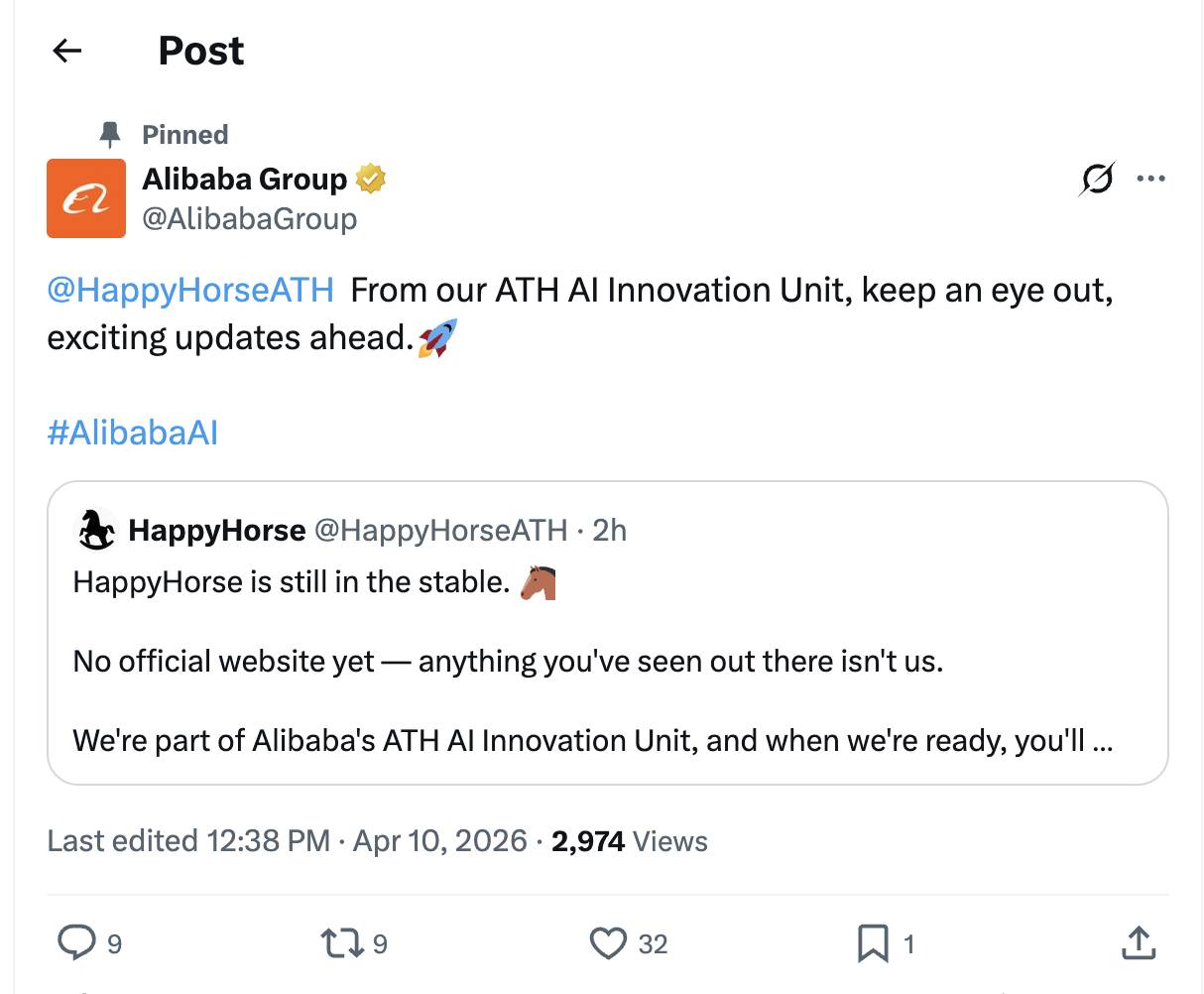
On April 10, 2026, the mystery was resolved.
HappyHorse-1.0 was confirmed to be developed by Alibaba Group, under:
- Taotian Group
- ATH-AI Innovation Division
Why This Confirmation Matters
This signals:
- Major tech companies are accelerating AI video development
- Competition is entering a new stage
- Enterprise-grade models are becoming more accessible
It also confirms:
👉 The performance is backed by serious infrastructure
👉 The model is part of a broader strategic initiative
Technical Positioning
HappyHorse-1.0 is built on a large-scale Transformer architecture designed for multimodal generation.
Key strengths:
- Unified audio-video modeling
- Strong temporal coherence
- High semantic accuracy
- Multi-scene generation capability
This allows:
- More realistic motion
- Better storytelling
- Higher consistency
Who Should Use HappyHorse-1.0
Content Creators
- Short-form video creators
- Social media producers
Marketers
- Advertising content
- Product videos
Educators
- Visual explanations
- Training materials
Developers
- API integrations
- AI-powered applications
Real-World Use Cases
Social Media Content
- Rapid video creation
- High engagement visuals
Marketing Campaigns
- Scalable ad production
- Faster iteration
Storytelling
- Multi-shot narratives
- Character-driven content
Image Animation
- Turning static assets into dynamic visuals
The Future of HappyHorse-1.0
With Alibaba backing the project, several developments are expected:
API Expansion
- Developer-friendly integrations
- Broader ecosystem adoption
Performance Improvements
- Faster generation speeds
- More efficient inference
Cost Optimization
- More accessible pricing
- Better scalability
Quality Enhancements
- Improved realism
- Stronger consistency
The Bottom Line
HappyHorse-1.0 is not just another AI video model.
It is a #1 ranked system on the Artificial Analysis leaderboards, validated by real users — not marketing claims.
It directly addresses critical pain points:
- ❌ Long queue times
- ❌ High costs
- ❌ Fragmented workflows
- ❌ Inconsistent results
And replaces them with:
- ✅ Fast generation
- ✅ Unified audio + video output
- ✅ Strong prompt control
- ✅ Scalable production
Most importantly:
It marks the transition from experimental AI video tools to production-ready systems.
With Alibaba officially entering the space, the competition is no longer just about quality.
👉 It is about speed, cost, and usability at scale.
And that is where the next phase of AI video begins.