Introduction
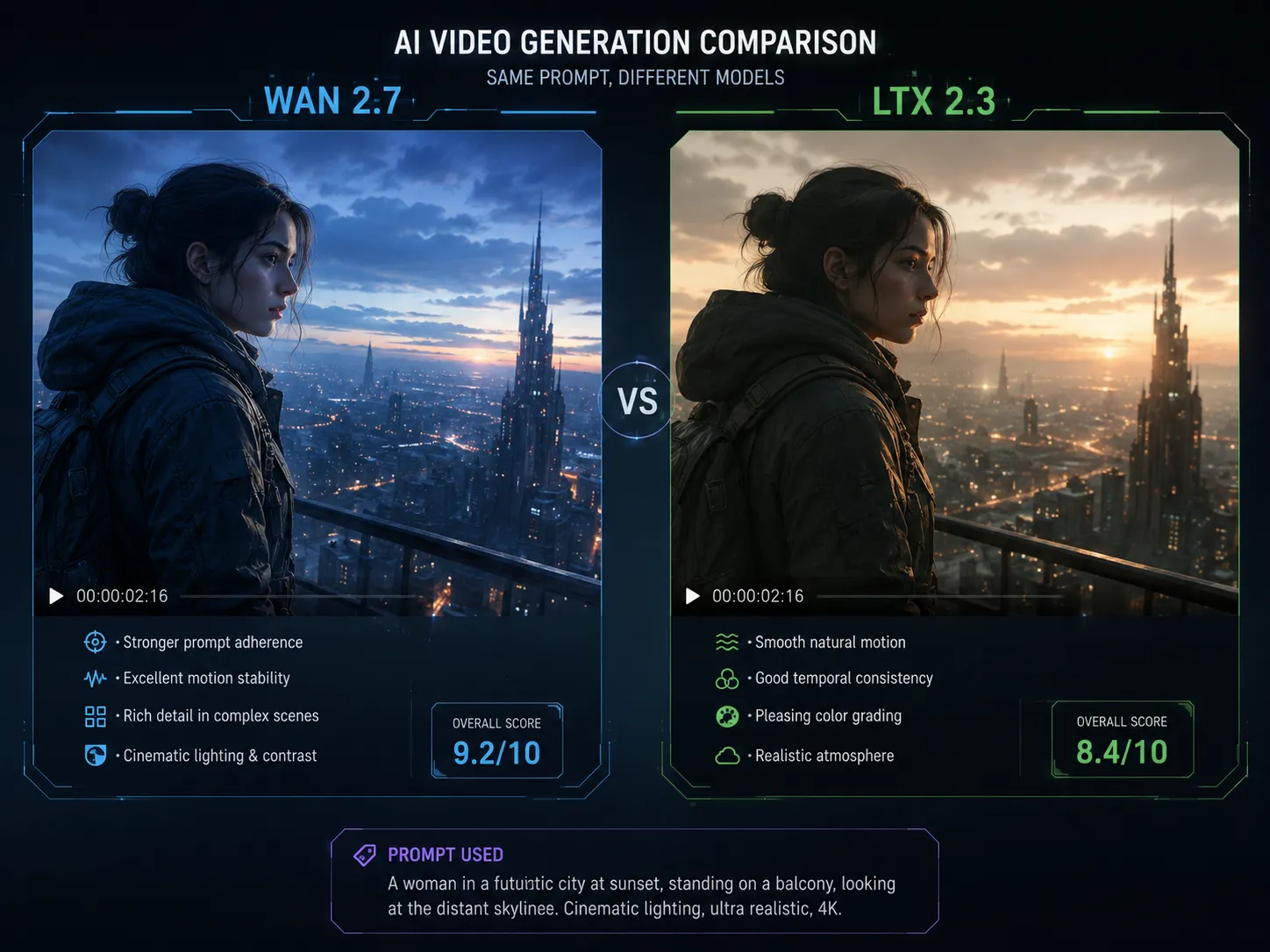
The Wan model family has been making steady progress since Wan 2.1, and Wan 2.7 established itself as a capable open-source video generation model — text-to-video, image-to-video, solid motion quality. But last week, the Wan team at Alibaba released something that goes in a completely new direction.
Wan Streamer v0.1 isn't another text-to-video model. It's an end-to-end real-time interactive foundation model: a single Transformer that listens, sees, thinks, and responds with synchronized audio and video. Put simply, it's an AI you can have a face-to-face video conversation with — under 200 ms latency, full-duplex, no external components.
This isn't an incremental update to Wan 2.7. It's a new architecture for a new kind of interaction. Here's what it does, how it works, and why it matters.
TL;DR
- Wan Streamer is a new model from Alibaba's Wan team — not text-to-video, but real-time audio-visual interaction
- End-to-end: a single Transformer handles vision, audio, language, and synchronized video generation
- 200 ms model-side latency, ~550 ms total — the only model delivering synchronized audio + video under one second
- Full-duplex: perceives user input while generating response, like a natural conversation
- Compares favorably against GPT-4o Realtime (speech-only), Doubao Voice (speech-only), and StreamAvatar/LPM (modular, higher true latency)
- v0.1 runs at 192p as a proof of concept; higher resolution is planned
- 24 researchers contributed to the arXiv paper, released June 24, 2026
From Text-to-Video to Real-Time Interaction
Wan 2.7 generates impressive video from text prompts and images. You describe what you want, and after processing time, you get a clip. It's a generation paradigm — request, wait, receive.
Wan Streamer operates on an entirely different paradigm: interaction. The model sits in a continuous loop:
- It receives video frames from your camera in real time
- It processes your speech audio as it arrives
- It interprets your facial expressions, tone, and words
- It generates its own synchronized video (face, expressions, lip movements) and audio (voice) as a continuous stream
- While generating, it keeps listening and watching — full-duplex, no turn-taking boundaries
This is not a pipeline of separate models glued together. Every capability — visual perception, language understanding, speech generation, video rendering — lives inside a single Transformer trained end-to-end.
Architecture Deep Dive
Single Transformer, Multiple Modalities
Standard multimodal models process text and images as input, then generate text as output. Video generation models take text as input and generate video as output. Wan Streamer does both directions for all modalities: the input sequence is an interleaving of video frames, audio chunks, and text tokens, and the output sequence is an interleaving of video frames and audio tokens.
Block-causal attention makes this streaming possible. Rather than attending to the entire input sequence before starting generation (which would introduce latency), block-causal attention lets the model process incoming tokens and generate outgoing tokens incrementally. New input blocks shift the causal window forward; output blocks are generated one streaming unit at a time.
Why No External Modules?
Every real-time avatar system before Wan Streamer — StreamAvatar, LPM 1.0, OmniForcing, Hallo-Live — is assembled from separate modules: an automatic speech recognition (ASR) engine, a large language model, a text-to-speech (TTS) system, and a talking-head renderer. Each module adds:
- Serial latency: data must pass through ASR → LLM → TTS → renderer in sequence
- Boundary overhead: reformatting data between module interfaces
- No end-to-end optimization: each module is trained independently
Wan Streamer eliminates all of this by training one model end-to-end. The paper reports ~200 ms model-side latency. Compare that to StreamAvatar's rendering-only latency of ~1.2 seconds — and StreamAvatar's figure excludes the LLM, ASR, and TTS latency on top of that.
Diffusion-Forcing and Self-Forcing
Two training techniques make the low-latency streaming possible:
Diffusion-forcing modifies the standard diffusion process so that each frame's generation depends on the model's own predictions for previous frames, rather than ground-truth values. This lets the model generate one streaming unit at a time without needing to look ahead at future frames.
Self-forcing extends this to the audio modality, ensuring that generated speech remains consistent with the visual output frame by frame.
Together, these techniques mean Wan Streamer doesn't need to buffer a complete response before starting to output — it can begin generating audio and video within 200 ms of receiving input.
How Wan Streamer Compares
Full Comparison Table
| System | Perceives video | Outputs video | Full-duplex | End-to-end | Sub-1s response |
|---|---|---|---|---|---|
| Wan Streamer | ✓ | ✓ | ✓ | ✓ | ✓ |
| GPT-4o Realtime | ✓ | ✗ | ~ | ✗ | ✓ |
| Doubao Voice | ✓ | ✗ | ✓ | ✗ | ~ |
| Gemini Live | ✓ | ✗ | ~ | ✗ | ~ |
| StreamAvatar | ~ | ✓ | ~ | ✗ | ✗ |
| LPM 1.0 | ~ | ✓ | ✓ | ✗ | ~ |
| OmniForcing | ~ | ✓ | ~ | ✗ | ~ |
| Hallo-Live | ~ | ✓ | ~ | ✗ | ✗ |
✓ = yes | ~ = partial / not disclosed | ✗ = no
Response Latency Comparison
- Wan Streamer — 0.2s model-side / 0.55s total (speech + video)
- GPT-4o Realtime — 0.23s / ~0.8s (speech only)
- Doubao Voice — 0.7s / ~1.0s (speech only)
- Gemini Live — 1.2–3.6s (speech only, rendering stage)
- StreamAvatar — ~1.2s (render only, excludes LLM/ASR/TTS)
- LPM 1.0 — ~0.35s (render only, excludes LLM/ASR/TTS)
Wan Streamer is the clear latency leader when you consider it's the only model producing synchronized audio + video from an end-to-end system.
What v0.1 Means for the Wan Ecosystem
Wan Streamer v0.1 is a research release — 192p resolution, proof-of-concept demos, not yet available as a product. But for anyone following the Wan model family, it signals a major expansion of scope.
The Wan team has shown capability in two directions:
- Wan 2.7: high-quality text-to-video and image-to-video generation for creators
- Wan Streamer: real-time audio-visual interaction for conversational AI
These are complementary. Wan 2.7 handles the asynchronous creation workflow — generate a video clip from a prompt. Wan Streamer handles the synchronous interaction workflow — have a real-time conversation with a visible AI agent. As the models mature, they could converge into a unified platform where you generate and interact with AI video content in the same ecosystem.
The Bottom Line
Wan Streamer v0.1 is a genuine technical achievement. It's the first end-to-end model to deliver synchronized audio + video interaction under 200 ms latency, full-duplex, without external ASR, LLM, or TTS modules. The single-Transformer architecture, block-causal attention, and diffusion-forcing training represent a different design philosophy from the modular avatar systems that came before.
It's early — 192p resolution, research-only, v0.1 — but the direction is clear. The Wan team is building toward a future where AI doesn't just generate video on demand, but interacts with you in real time, face to face.
FAQ
What is Wan Streamer?
Wan Streamer is an end-to-end real-time interactive foundation model from Alibaba's Wan team. It processes video, audio, and text input and generates synchronized video and audio output within a single Transformer — at roughly 200 ms model-side latency.
How is Wan Streamer different from Wan 2.7?
Wan 2.7 is a text-to-video and image-to-video generation model. Wan Streamer is an interactive model for real-time audio-visual conversation. They serve different use cases: generation vs. interaction.
Does Wan Streamer use separate ASR or TTS?
No. Language, audio, and video are all handled by one end-to-end Transformer. No external automatic speech recognition, large language model, or text-to-speech system is required.
How fast is Wan Streamer?
Model-side response latency is approximately 200 ms. Total interaction latency including bidirectional network is approximately 550 ms.
What resolution does Wan Streamer output?
The v0.1 release runs at 192p. The team states that higher resolution scales readily and is planned for future work.
Is Wan Streamer open-source?
The paper and project website are publicly available. Check wan-streamer.com for the latest on model access and licensing.
Who created Wan Streamer?
Wan Streamer was developed by 24 researchers from Alibaba's Wan team. The paper was submitted to arXiv on June 24, 2026.
Can I try Wan Streamer today?
Research demos are available on the project website at wan-streamer.com. It is not yet available as a consumer or API product.
References
- Wan Streamer Official Page
- Wan Streamer v0.1 Paper (arXiv)
- Alibaba Wan Team GitHub
- Wan 2.7: Open-Source Video Generation
- [Block-Causal Attention for Streaming Models (related work)]