Open-weight AI video models are changing the game — anyone with a GPU can now generate professional-quality video without paying per-generation API fees. Two of the most popular open models right now are Alibaba's Wan 2.7 and Lightricks' LTX 2.3.
Both run locally, both produce impressive results, but they target very different users. Here's how they compare.
TL;DR
- Wan 2.7 is the higher-quality model overall — better prompt adherence, longer clips, and sharper output. It also includes image generation capabilities.
- LTX 2.3 is the speed king — it generates video in near real-time on consumer hardware, making it ideal for iteration-heavy workflows.
- Wan 2.7 requires more VRAM (24GB for 720p) but delivers better results. LTX 2.3 runs on as little as 8GB VRAM and generates 5-second clips in seconds.
- Choose Wan 2.7 for quality, LTX 2.3 for speed and accessibility.
Quick Comparison Table
| Dimension | Wan 2.7 | LTX 2.3 |
|---|---|---|
| Developer | Alibaba | Lightricks |
| Model Access | Open weights | Open weights |
| Input Types | Text, Image | Text, Image |
| Max Resolution | 720p-1080p | 768×512 (SD), 1024×576 (HD) |
| Max Duration | 10s | 5s (extendable to 121 frames) |
| Image Gen? | ✅ Yes | ❌ No |
| VRAM Requirement | 24GB (720p) | 8GB |
| Speed | ~60-120s for 5s clip | ~10-15s for 5s clip (real-time) |
| Quality Ranking | Higher | Lower (good for style transfers) |
| Best for | Production-quality video | Quick iteration, prototyping |
Quality Comparison
Tested with the same prompt: "a cinematic shot of a cyberpunk city street at night, neon reflections on wet pavement, a holographic dragon flying through the air."
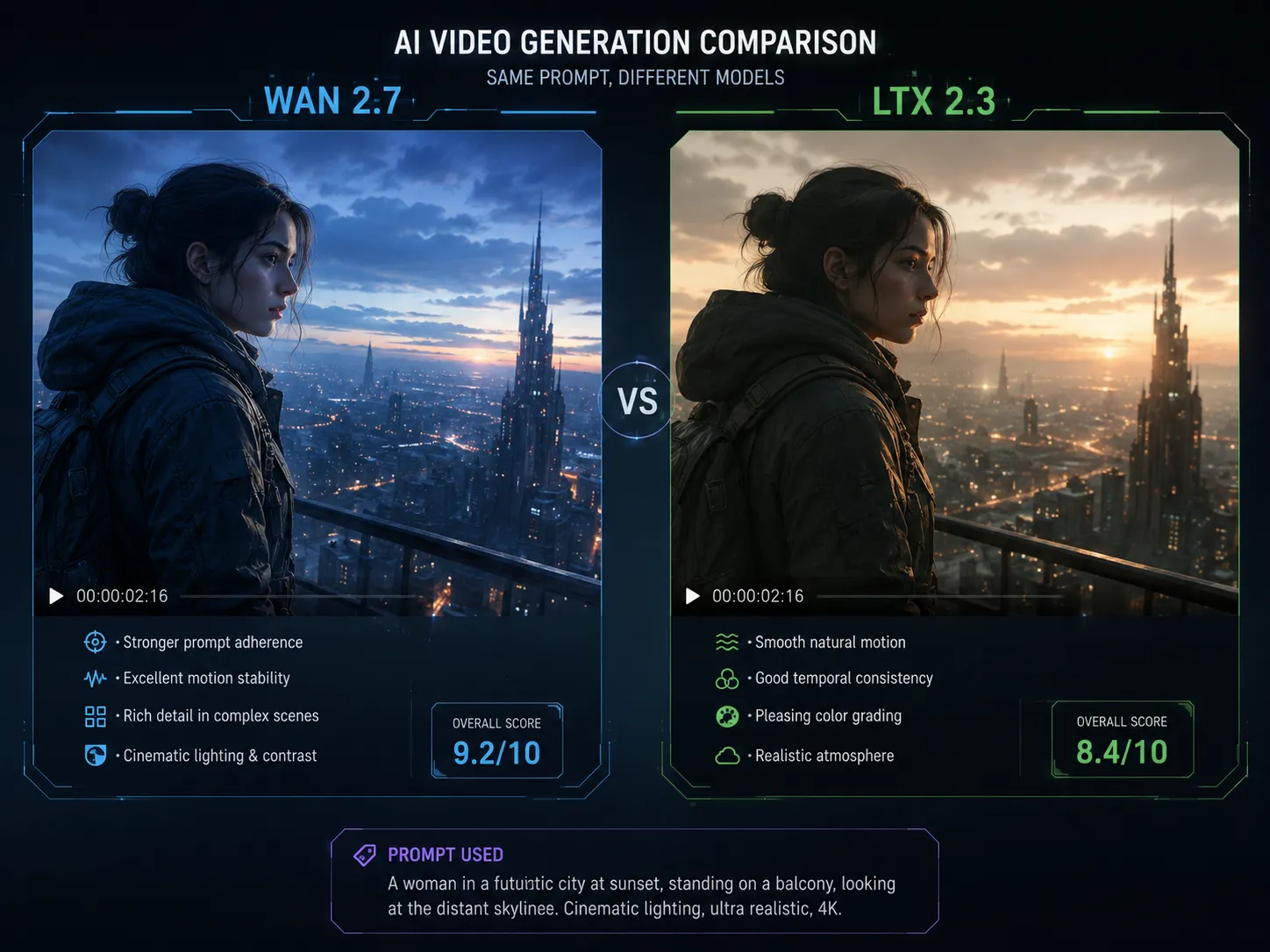
Wan 2.7 produced a 10-second clip at 720p that was genuinely impressive — the neon reflections shimmered, the holographic dragon had convincing translucency, and the camera motion was smooth throughout. The level of detail in the wet pavement reflections was particularly notable.
LTX 2.3 at 768×512 was noticeably softer. The composition was correct but fine details like text on neon signs and dragon scales were less defined. However, the clip was generated in under 15 seconds — about 10x faster than Wan 2.7.
Verdict: Wan 2.7 wins on quality by a clear margin. LTX 2.3 is good enough for concept visualization but not for final output.
Hardware Requirements
This is where LTX 2.3 shines. It's designed to run on consumer GPUs:
- LTX 2.3: 8GB VRAM minimum. Runs on RTX 3070, RTX 4060, M-series MacBooks.
- Wan 2.7: 24GB VRAM for 720p. Runs on RTX 4090, A5000, M3 Max / M4 Ultra.
If you don't have a high-end GPU, LTX 2.3 is effectively your only option for local generation. Wan 2.7 users will need to use cloud APIs (which is where wan27ai.net comes in).
Speed Comparison
| Task | Wan 2.7 | LTX 2.3 |
|---|---|---|
| 5-second 720p generation | ~120s | ~12s |
| Image-to-video (5s) | ~90s | ~15s |
| Iteration cycle (prompt → see result) | ~2min | ~15s |
For creative workflows where you're iterating on prompts rapidly, LTX 2.3's speed advantage is enormous. For one-shot generation where quality matters, Wan 2.7 is worth the wait.
Image-to-Video
Both models support image-to-video. Wan 2.7's implementation is more mature — the generated video maintains better character consistency with the source image, and motion artifacts are less common. LTX 2.3 can produce good results but the motion can feel less grounded.
Wan 2.7's unique advantage: it generates the source image AND the video in one system. LTX 2.3 needs an external image generator.
Who Should Use What?
Choose Wan 2.7 if:
- You need production-quality video output
- You want an all-in-one image + video solution
- You have a high-end GPU (24GB+) or use cloud APIs
- You need longer clips (up to 10s)
Choose LTX 2.3 if:
- You're working on a consumer GPU (8-12GB VRAM)
- You need fast iteration for creative prototyping
- You don't need maximum quality
- You want to experiment with local model inference
Final Verdict
LTX 2.3 is an impressive technical achievement — near real-time video generation on consumer hardware is remarkable. But for anyone who needs actual production-quality output, Wan 2.7 is the clear winner.
The easiest way to use Wan 2.7 without the hardware requirements is through wan27ai.net — just paste your prompt and get high-quality video in under 2 minutes, no GPU required.